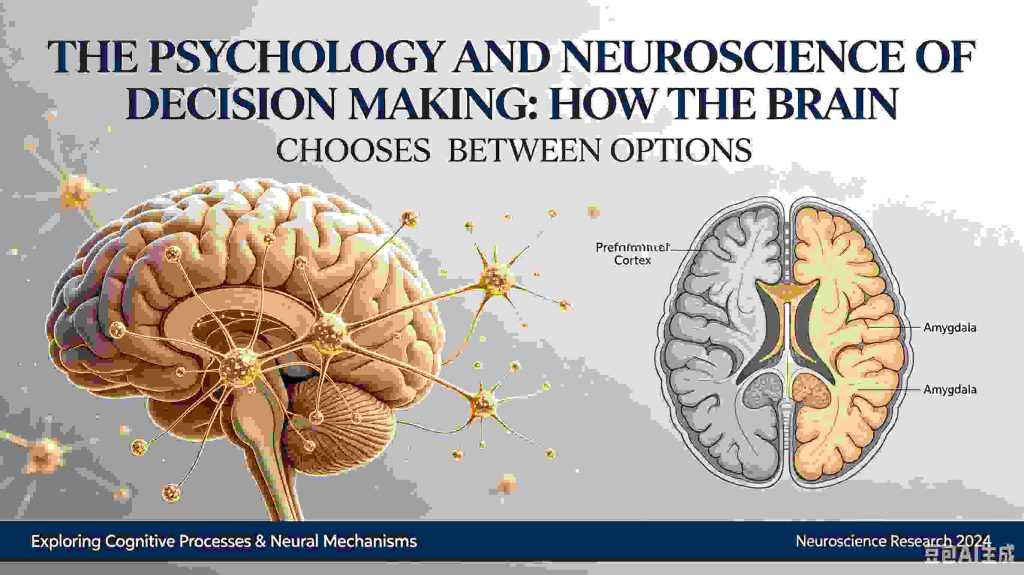
At the core of decision making lies the brain’s ability to evaluate options and predict outcomes based on available information. The prefrontal cortex plays a central role in this process, particularly in higher-order reasoning, planning, and impulse control. When faced with a choice, the brain attempts to weigh potential rewards and risks associated with each option. However, this evaluation is not purely logical. Neural activity in regions such as the ventromedial prefrontal cortex and the striatum integrates emotional and motivational signals, helping to assign subjective value to different possibilities. This means that decisions are influenced not only by objective data but also by how strongly an individual feels about certain outcomes. The interaction between cognitive control systems and emotional processing systems creates a dynamic balance that guides behavior in complex and often unpredictable ways.
One of the key findings in decision science is that humans rely heavily on cognitive shortcuts, known as heuristics, to make decisions efficiently. While these mental shortcuts are useful for handling large amounts of information quickly, they can also lead to systematic errors known as cognitive biases. For example, the availability heuristic causes people to judge the likelihood of events based on how easily examples come to mind, which can lead to overestimating rare but memorable events. The confirmation bias leads individuals to seek out information that supports their existing beliefs while ignoring contradictory evidence. These biases demonstrate that human decision making is not always rational in the traditional economic sense but is instead shaped by mental efficiency strategies that evolved to help the brain operate under conditions of limited time and information.
Neuroscience research has also revealed the important role of neurotransmitters in shaping decision making. Dopamine, in particular, plays a crucial role in reward processing and motivation. When the brain anticipates a reward, dopamine neurons become active, reinforcing behaviors that are associated with positive outcomes. This mechanism helps individuals learn from experience and adjust future decisions based on past results. However, it can also contribute to addictive behaviors when the reward system becomes overly stimulated by substances or activities that produce intense pleasure. Other neurotransmitters, such as serotonin and norepinephrine, influence mood regulation, risk perception, and attention, further affecting how decisions are made under different emotional and physiological states.
Emotion is deeply intertwined with decision making, often playing a more significant role than people realize. Contrary to the traditional view that emotions interfere with rational thinking, research shows that emotional signals are essential for making effective decisions. The amygdala, a brain structure involved in processing emotions such as fear and pleasure, helps individuals quickly assess potential threats or rewards. Emotional experiences from the past are stored in memory systems and can influence future choices through associative learning. For example, a negative experience associated with a particular situation may lead to avoidance behavior in similar future contexts. In many cases, emotions serve as a rapid evaluation system that complements slower, more deliberate reasoning processes in the prefrontal cortex.
Decision making under uncertainty is another important area of research in psychology and neuroscience. In real-world situations, individuals rarely have complete information about the consequences of their actions. Instead, they must rely on probabilities, assumptions, and incomplete data. The brain uses statistical learning mechanisms to estimate likelihoods and update beliefs based on new information. However, humans often struggle with probabilistic reasoning, leading to predictable errors such as overconfidence or risk aversion. Prospect theory, developed by behavioral economists, explains how people tend to value potential losses more strongly than equivalent gains, a phenomenon known as loss aversion. This asymmetry in perception significantly influences financial decisions, consumer behavior, and risk-taking strategies.
Social influences also play a major role in shaping decision making. Humans are inherently social beings, and the opinions, behaviors, and expectations of others can strongly affect individual choices. Brain imaging studies have shown that social approval activates reward-related neural circuits, suggesting that social acceptance is intrinsically rewarding. Conformity, peer pressure, and cultural norms all contribute to shaping decisions in group contexts. Additionally, theory of mind, the ability to understand the thoughts and intentions of others, allows individuals to anticipate how their choices will be perceived and to adjust behavior accordingly. This social dimension of decision making highlights that choices are not made in isolation but are deeply embedded within interpersonal and cultural environments.
Advances in neuroscience and artificial intelligence are beginning to converge in the study of decision making. Computational models of the brain are being developed to simulate how neural networks evaluate options, learn from feedback, and adapt to changing environments. These models are influencing the design of AI systems capable of making autonomous decisions in fields such as robotics, finance, and healthcare. At the same time, insights from AI research are helping scientists better understand human cognition by comparing biological decision making with machine learning algorithms. As this interdisciplinary field continues to grow, it may eventually lead to technologies that enhance human decision making, improve mental health treatments, and provide deeper insights into the nature of consciousness and intelligence.
Understanding the psychology and neuroscience of decision making reveals that human choices are the result of complex interactions between rational thought, emotional processing, past experiences, and social context. Rather than being purely logical or entirely emotional, decisions emerge from dynamic brain systems that evolved to help humans survive and adapt in uncertain environments. Continued research in this field has the potential to improve education, healthcare, economics, and artificial intelligence, while also helping individuals make more informed and balanced decisions in their daily lives. By studying how the brain chooses, scientists are uncovering fundamental principles of human behavior that shape not only individual lives but also societies as a whole.