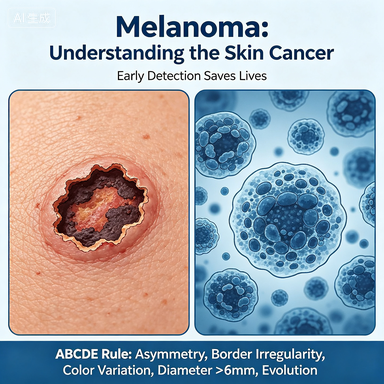
An Overview of Melanoma Melanoma is a serious form of skin cancer that begins in the melanocytes, the cells responsible for producing pigment. While less common than basal cell and squamous cell skin cancers, melanoma is more dangerous due to its ability to spread rapidly to other organs if not caught early.
Early detection significantly increases the likelihood of successful treatment. While melanoma can develop anywhere on the skin, it’s most commonly found on areas with sun exposure, such as the back, legs, arms, and face. Regular self-examinations and professional skin checks are essential for early identification.
Recognizing Early Signs: The ABCDEs of Melanoma Dermatologists often use the ABCDE rule as a practical guide to help identify suspicious moles that could indicate melanoma. Each letter represents a visual characteristic that may signal that a skin lesion needs medical evaluation.
A – Asymmetry: Benign moles are usually symmetrical, meaning if you draw a line through the middle, both halves look similar. Melanomas are often asymmetrical, where one half looks different in shape or thickness from the other.
B – Border: Healthy moles tend to have smooth, clearly defined edges. Melanomas frequently have irregular, jagged, blurred, or scalloped borders, which can make the spot appear uneven.
C – Color: Most harmless moles are a single shade of brown. Melanoma may display multiple colors within the same lesion, including different shades of brown, black, tan, red, white, or blue. Uneven color distribution can be an early warning sign.
D – Diameter: Melanomas are often larger than 6 millimeters (about the size of a pencil eraser) when diagnosed, although they can be smaller in early stages. Any mole that is noticeably growing should be examined.
E – Evolving: One of the most important warning signs is change over time. This includes changes in size, shape, color, elevation, or symptoms such as itching, bleeding, or crusting.
Regular self-examinations using the ABCDE method can help people notice suspicious changes early. Early detection significantly improves treatment outcomes, so any mole that meets one or more of these criteria should be evaluated by a dermatologist.
Common Early-Stage Melanoma Appearances Early-stage melanoma can appear in several ways, which is why routine skin checks are important. Many melanomas start as new spots on the skin, while others develop from changes in an existing mole.
A typical early melanoma may appear as a flat or slightly raised lesion with irregular edges. The surface may display several shades of brown or black, and the shape is often uneven. Over time, the spot may gradually grow or change in color or texture.
Some melanomas may also appear pink, red, purple, or flesh-colored rather than dark. These variations can make them harder to recognize, especially when they resemble harmless skin growths or irritation.
A less common form known as amelanotic melanoma contains little or no pigment. These lesions may appear pale, pink, or translucent rather than dark, which means they may not immediately resemble typical moles. Because of this, they are sometimes overlooked during skin checks.
Monitoring your skin for new growths, unusual spots, or changes in existing moles is an important part of early melanoma detection.
Melanoma in Uncommon Locations Although melanoma is strongly associated with sun exposure, it can develop in areas of the body that receive little or no sunlight. Because these areas are often overlooked, melanomas there may be discovered later than those on more visible skin.
Less common locations include the palms of the hands, soles of the feet, under fingernails or toenails, and between the toes. A form called acral lentiginous melanoma is more likely to appear in these regions and may look like a dark streak under the nail or a slowly growing spot on the palm or sole.
Melanoma can also occur on mucosal surfaces, including inside the mouth, nose, or genital region. These cases are rare but can be more difficult to detect because they develop in areas that people do not regularly examine.
For thorough skin monitoring, it’s recommended to check all areas of the body, including the scalp, back, and under nails. If you notice any new or unusual spots—especially those that grow, change, or look different from other moles—seeking prompt evaluation from a dermatologist is an important step for early diagnosis.
Preventive Measures and Regular Monitoring Preventive measures include using broad-spectrum sunscreen, wearing protective clothing, and avoiding peak sun hours. Regular self-examinations and annual skin checks with a dermatologist are essential for monitoring changes in your skin.
Early detection through regular monitoring can significantly improve treatment outcomes for melanoma. By taking proactive steps to protect your skin and being aware of the early signs, you can help prevent serious complications from melanoma.
Key Takeaways Melanoma can be deadly if not detected early, but recognizing the early signs can make a significant difference. Familiarize yourself with the ABCDEs of melanoma and regularly examine your skin for any new or changing spots.
Consult a dermatologist for any suspicious changes, especially in uncommon areas. Combining preventive measures with regular monitoring is your best defense against melanoma, ensuring you maintain optimal skin health.
This article is for informational purposes only and is not intended as medical advice. Always consult a qualified healthcare professional for diagnosis or treatment.