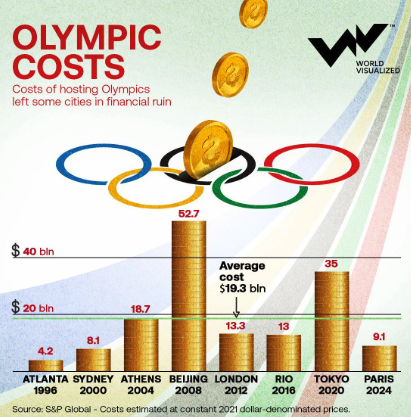
The cost structure is staggeringly front-loaded. Host cities must construct Olympic Village housing, aquatic centres, media broadcast complexes, and often entirely new stadiums. These are capital-intensive projects that require massive loans, municipal bonds, and central government subsidies. The Barcelona 1992 Games, often cited as the success story, revitalized the city’s waterfront and generated long-term tourism gains, but such outcomes are the exception rather than the rule. Rio 2016 built grand venues that are now crumbling, with the aquatic centre closed within two years and the Olympic Park used as a bus depot. The problem is legacy—or the lack thereof. Cities overestimate post-Games demand, and underuse leads to maintenance costs that far exceed revenue.
Operating revenues come primarily from broadcasting rights, sponsorship, and ticket sales. The International Olympic Committee (IOC) sells global broadcast rights for billions—the Tokyo 2020 rights alone fetched $3.3 billion—but the IOC retains roughly 90% of that revenue, distributing only a small portion to the host organizing committee. Similarly, TOP sponsors (Coca-Cola, Visa, Toyota) pay hundreds of millions to the IOC, but local organizing committees receive a fraction. Ticket sales, pre-COVID, accounted for about 20% of revenue, but even sell-out crowds cannot offset construction costs. In fact, a 2024 report by the National Bureau of Economic Research found that, when adjusting for inflation, no Summer Olympics since 1996 has generated a net economic benefit for the host city.
The Paris 2024 Olympics, however, aimed to break the mould. Organizers pledged a “lean Games,” utilizing 95% existing or temporary venues, including the Stade de France and the Grand Palais. The projected budget of €4.4 billion (operational) plus €3.2 billion (infrastructure) is modest by recent standards. Paris also prioritized sustainable transport and carbon offsetting, aligning with IOC’s new reform agenda, Agenda 2020, which encourages “flexible, sustainable, and athlete-centred” Games. Early indicators are promising: Paris is on track to achieve a 55% reduction in carbon emissions compared to London 2012, and ticket sales have been robust. Yet even Paris faces headwinds—security costs have risen by 40% due to terrorist threats, and local protests over gentrification and police presence have soured public opinion.
The Los Angeles 2028 Olympics represent another experiment. LA will use no new permanent structures for the Olympics, relying on the Coliseum, SoFi Stadium, and UCLA facilities. The city also operates a “legacy-first” model, ensuring that every venue has a post-Games tenant. Crucially, LA has secured private investment for 80% of its budget, reducing the burden on taxpayers. The strategy has won praise, but it also depends on a booming US economy and stable insurance markets. Brisbane 2032 will follow a similar “no new builds” approach, using existing venues from rugby and cricket.
The most radical proposal comes from the IOC itself: rotating the Games among a shortlist of “permanent hosts” to eliminate construction costs entirely. Under this model, the Summer Olympics would be hosted by the same five cities every 20 years—London, Sydney, Beijing, Los Angeles, and Tokyo—allowing them to optimize infrastructure over multiple cycles. This would dramatically reduce costs and environmental impact but would exclude much of the Global South, undermining the Olympic ideal of universality. Critics argue that permanent hosting would transform the Olympics into a commercial franchise, further distancing the movement from Pierre de Coubertin’s amateur vision.
The Olympic economic challenge ultimately reduces to a simple question: Is national prestige worth billions of dollars of public money? For emerging economies, the answer has often been yes, driven by political will and public enthusiasm. For established nations, the calculus is shifting toward restraint. The 2024 and 2028 Games may demonstrate that the Olympics can survive without fiscal ruin, but only if host cities resist the temptation to build monuments and embrace pragmatism. The future of the Games depends not on medals, but on balance sheets.