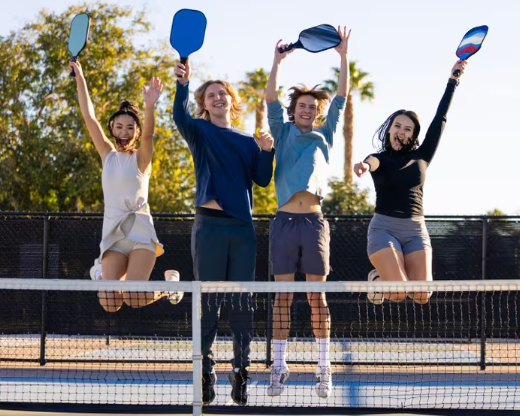
The most obvious driver is the sport’s accessibility. Pickleball is played on a court roughly one-third the size of a tennis court, with a lower net and a perforated plastic ball that travels 30% slower than a tennis ball. These modifications drastically reduce the physical demands; players do not need exceptional speed, strength, or endurance. The underhand serve and the “two-bounce” rule (the ball must bounce once on each side before volleys are allowed) make the game immediately playable for beginners. The learning curve is remarkably short; most players can hold a rally within 20 minutes. This low barrier to entry has attracted demographics that are often marginalized in traditional sports: seniors, young children, and individuals with limited mobility. The average age of a pickleball player is 38, but the fastest-growing segment is players over 65, who appreciate the low-impact nature and reduced injury risk.
The social element is equally critical. Pickleball is inherently social; doubles is the most popular format, requiring four players to interact continuously. The smaller court encourages conversation, and games are shorter (typically 15–20 minutes), allowing players to rotate partners frequently. This contrasts with tennis, where singles matches can last two hours and require intense mental isolation. Pickleball has been described as “the sport of conversations”—a place where friendships form, business deals are discussed, and communities bond. Municipalities have responded by converting underused tennis courts into dedicated pickleball facilities; Florida alone added 1,200 new courts in 2023. The sport has even become a real estate amenity, with luxury apartment complexes in major cities advertising pickleball courts as a selling point.
Professionalization has followed the grassroots boom. The Professional Pickleball Association (PPA) and the Association of Pickleball Professionals (APP) merged in 2024 to form a unified tour with $10 million in annual prize money. Top players like Ben Johns and Anna Leigh Waters, both in their early 20s, have amassed six-figure earnings and endorsement deals with Franklin Sports and Selkirk. The 2023 Pickleball Slam, featuring retired tennis legends Andre Agassi and John McEnroe, drew over 1 million viewers on ESPN, proving the sport’s crossover appeal. Several NBA team owners, including the owners of the Miami Heat and the Milwaukee Bucks, have purchased PPA franchises, betting that pickleball will sustain its growth.
Despite these successes, the sport faces growing pains. Injury rates are rising, particularly among older players; rotator cuff strains, Achilles tendon ruptures, and wrist fractures have increased by 22% since 2022, according to a study in the American Journal of Sports Medicine. The sport’s quick-start nature encourages overexertion in deconditioned participants. Moreover, the influx of young, athletic players has intensified the competitive level, creating a gap between casual recreational play and tournament-level intensity. This has led to tensions at public courts, where retirees complain of “hijacked” facilities by younger players. Communities are addressing this by allocating separate courts for open play and competitive matches.
The future trajectory is uncertain. Some analysts compare pickleball to racquetball, which boomed in the 1970s and then faded, while others see it as a permanent fixture, akin to tennis. The sport’s advantage is its adaptability; it can be played indoors or outdoors, on composite or concrete surfaces, and with minimal equipment. Professional projections estimate that pickleball will reach 30 million players by 2028, making it the third-most-participated sport in the US, behind only basketball and running. The international expansion is also underway; Canada, the UK, and Australia have all seen triple-digit growth rates. If pickleball can avoid the commercialization trap that alienates casual players, it may indeed sustain its rise. For now, the sport is riding a wave of enthusiasm that shows no signs of breaking.