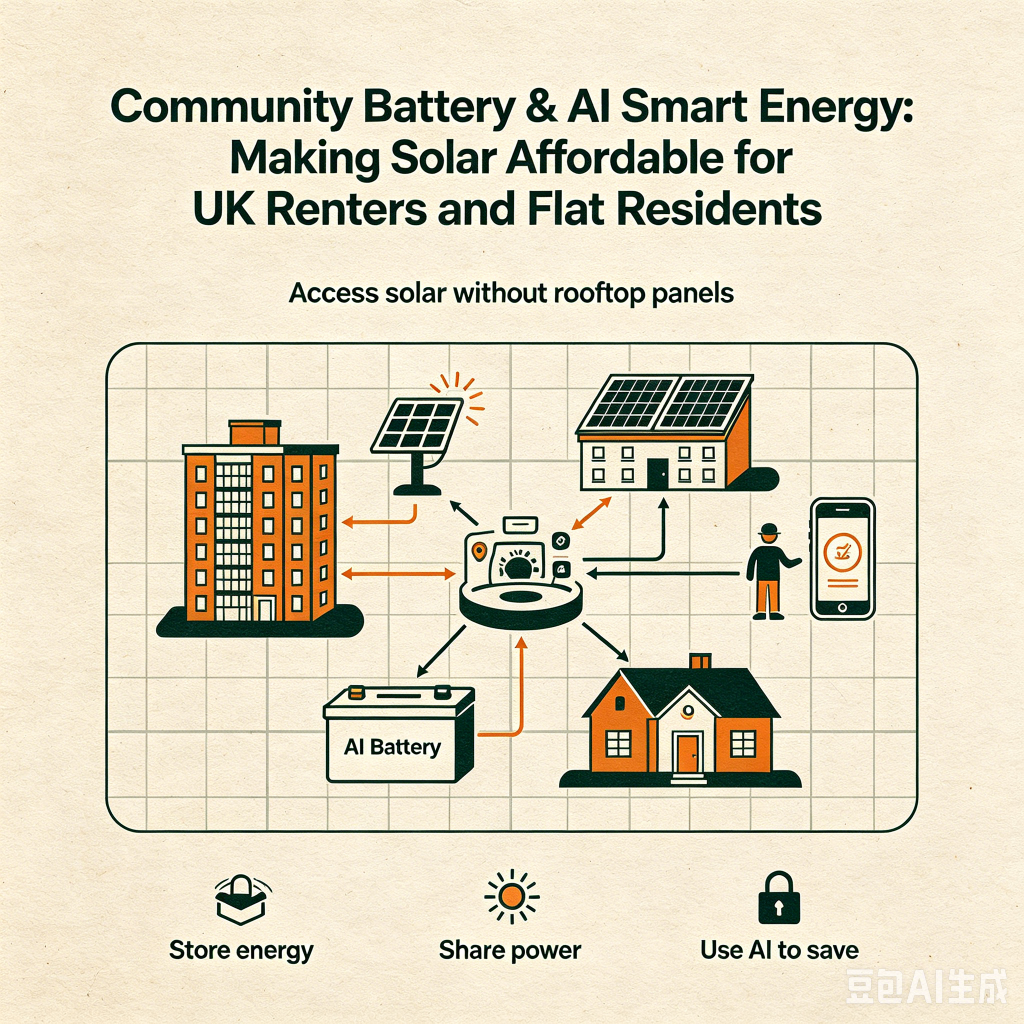
Traditional rooftop solar adoption in Britain skews heavily toward homeowners with detached properties, leaving over two-thirds of urban residents living in apartment buildings with no personal access to self-generated solar power. Community solar projects install large panel arrays on communal building roofs, library rooftops, leisure center structures, and local warehouse spaces within a two-kilometer neighborhood radius, pooling total generation for all participating households in the surrounding area. Central AI management software serves as the core operational backbone for every successful UK community battery installation. This platform continuously measures total solar energy generation, collective household demand across participants, battery storage charge levels, and Smart Export Guarantee (SEG) grid export rates in real time. The algorithm dynamically splits generated power between direct resident consumption, battery storage reserves, and grid sales to maximize collective monthly income and savings for the whole community group. For individual participants, subscription structures eliminate large upfront costs that prevent low- and middle-income families from entering renewable energy schemes. Residents sign simple monthly agreements to claim a share of the community solar output, receiving automatic credits applied directly to their regular electricity supplier bills each billing cycle. Administrative work, equipment maintenance, and system repairs fall entirely under the project operator’s responsibility, removing hassle for renters and busy households. Government-backed community battery trials in London boroughs such as Lambeth have recorded measurable annual savings for participating flat residents, averaging roughly £180 per household each year from combined solar usage, stored energy access, and grid flexibility payment revenue. Larger residential microgrid developments in Dorset have scaled these results further, cutting annual energy expenditure by approximately £1,300 per home for fifty-four-unit net-zero housing developments using AI-coordinated solar, battery storage, and electric vehicle charging infrastructure. UK electricity grid instability during winter peak hours creates extra strain from nationwide heating demand, and AI community batteries deliver grid balancing benefits alongside household savings. When national electricity demand spikes in early evening winter windows, the system discharges stored solar energy into the local distribution network, earning additional flexibility service payments that get divided equally among all community participants as quarterly dividend payouts. MCS certification standards regulate all solar and battery installations operating within UK community energy projects, ensuring safety, technical compliance, and consistent performance for every participant. AI monitoring tools flag underperforming solar panels, faulty battery cells, or wiring issues immediately, alerting maintenance teams to schedule targeted repairs before overall community energy output declines noticeably. Proactive diagnostics reduce downtime far more effectively than manual quarterly inspections. Smart Export Guarantee revenue optimization represents another key advantage of AI-controlled community energy systems in Britain. Instead of exporting excess solar power uniformly throughout the day at fixed SEG rates, the algorithm holds surplus energy in battery storage during low-price midday windows, exporting electricity during late afternoon price peaks to secure higher per-kilowatt-hour compensation from energy suppliers. This small scheduling adjustment lifts total annual SEG income significantly for collective projects. Tenant eligibility rules have been relaxed across most UK local councils to encourage wider community solar participation, ending previous barriers that limited schemes to long-term leaseholders only. Housing associations now actively partner with energy developers to roll out shared battery infrastructure on social housing estates, supporting vulnerable households most vulnerable to fluctuating energy market prices and fuel poverty challenges nationwide. Mobile app dashboards give every community member full transparency into personal energy allocation, monthly savings accumulation, total community solar production, and battery reserve status. Users can view simple monthly breakdowns showing exactly how much solar energy they consumed directly versus how much credit they earned from exported surplus power, building clear understanding of how shared renewable systems operate day-to-day. Battery hardware costs have fallen by roughly forty percent in the UK since 2020, making community solar projects financially viable without reliance on continuous government grant funding. While no nationwide dedicated battery subsidy exists, targeted Warm Homes local grants and national rooftop solar expansion incentives indirectly support shared storage development by reducing overall project construction overheads for operators. Long-term carbon reduction targets set by the UK parliament position community AI energy networks as a critical piece of national net-zero strategy by 2050. Scaling neighborhood battery deployments cuts reliance on gas-fired peaker power plants activated during demand surges, lowering national greenhouse gas emissions while delivering tangible financial relief to demographics previously excluded from solar energy advantages. Future policy consultations underway in Westminster aim to remove remaining regulatory hurdles for neighborhood energy trading, allowing AI-managed community batteries to facilitate direct peer-to-peer solar electricity sales between nearby households, further increasing economic efficiency and consumer control over personal energy spending in British residential neighborhoods.

-3-300x300.png)
-4-300x300.png)
-2-1-300x300.png)