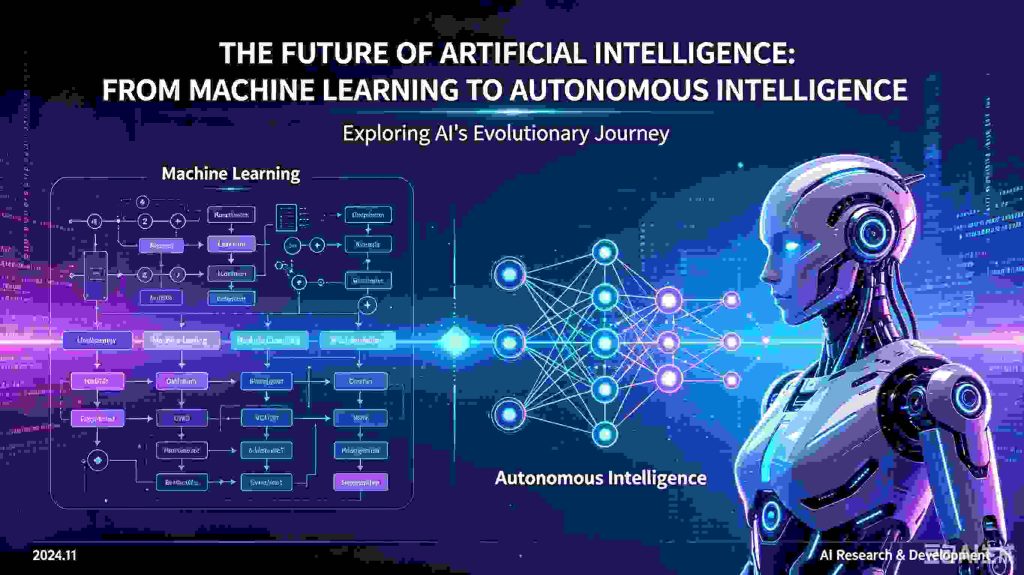
At the core of modern AI is machine learning, a computational approach that allows systems to learn patterns from data without being explicitly programmed for every task. Instead of following fixed instructions, machine learning algorithms analyze large datasets, identify statistical relationships, and improve their performance over time. Deep learning, a subset of machine learning, uses artificial neural networks inspired by the structure of the human brain. These networks consist of multiple layers that process information hierarchically, enabling systems to recognize images, understand language, and make predictions with remarkable accuracy. The success of deep learning has driven major breakthroughs in speech recognition, natural language processing, and computer vision.
One of the most significant developments in AI is the rise of large language models, which are trained on vast amounts of text data to generate human-like language. These models can answer questions, write essays, summarize information, translate languages, and even assist in coding and scientific research. Their ability to understand context and generate coherent responses has made them widely applicable across many domains. However, despite their impressive capabilities, these systems do not possess true understanding or consciousness. They operate based on statistical patterns rather than genuine comprehension, which raises important questions about the limits of machine intelligence and the differences between simulation and human cognition.
AI is also transforming industries through automation and optimization. In manufacturing, intelligent systems control robotic assembly lines with high precision and efficiency. In healthcare, AI assists in diagnosing diseases, analyzing medical images, and predicting patient outcomes. In finance, algorithms detect fraudulent transactions, optimize investment portfolios, and assess risk in real time. Transportation systems use AI for route optimization, traffic prediction, and the development of autonomous vehicles. These applications demonstrate how AI enhances productivity by performing tasks that are repetitive, data-intensive, or require rapid decision-making beyond human capability. As a result, AI is increasingly becoming an integral part of global economic infrastructure.
Despite its benefits, artificial intelligence also raises significant ethical and societal challenges. One major concern is the impact of automation on employment. As AI systems become more capable, there is potential for certain jobs to be displaced, particularly those involving routine or predictable tasks. However, AI is also expected to create new job categories that require advanced technical skills, creativity, and human-AI collaboration. Another concern involves algorithmic bias, where AI systems may unintentionally reproduce or amplify biases present in training data. This can lead to unfair outcomes in areas such as hiring, lending, and law enforcement. Addressing these issues requires transparency, accountability, and careful design of AI systems.
Privacy and data security are also critical issues in the age of artificial intelligence. Many AI systems rely on large datasets that include personal information, raising concerns about how data is collected, stored, and used. Ensuring that AI respects user privacy while maintaining functionality is a key challenge for developers and policymakers. In addition, the increasing sophistication of AI-generated content has led to concerns about misinformation, deepfakes, and digital manipulation. As AI becomes more powerful, distinguishing between real and synthetic information may become increasingly difficult, requiring new tools for verification and digital literacy.
Another important area of AI research is the development of artificial general intelligence (AGI), a hypothetical form of AI that would possess the ability to understand, learn, and apply intelligence across a wide range of tasks at a level comparable to or exceeding human cognition. While current AI systems are specialized and limited to specific tasks, AGI would represent a major leap forward in computational intelligence. Researchers remain divided on how close we are to achieving AGI, and whether it is even achievable with current technological paradigms. Nevertheless, progress in neural networks, reinforcement learning, and cognitive modeling continues to push the boundaries of what AI systems can do.
The future of artificial intelligence is likely to involve deeper integration with human life and other emerging technologies. AI will play a central role in scientific discovery, helping researchers analyze complex data and generate new hypotheses in fields such as physics, biology, and climate science. It will also contribute to personalized education, adaptive healthcare, and intelligent infrastructure systems. As AI systems become more advanced, they may increasingly function as collaborative partners rather than simple tools, assisting humans in decision-making and problem-solving at unprecedented scales.
Artificial intelligence represents both an extraordinary opportunity and a profound challenge for humanity. Its continued development will require careful balancing of innovation, ethics, and regulation to ensure that its benefits are widely shared and its risks are managed responsibly. As AI systems become more powerful and autonomous, society will need to redefine its relationship with technology, intelligence, and even creativity itself. The future of AI is not only about machines becoming smarter, but also about how humans choose to guide and integrate this intelligence into the fabric of civilization.
-4-300x300.png)