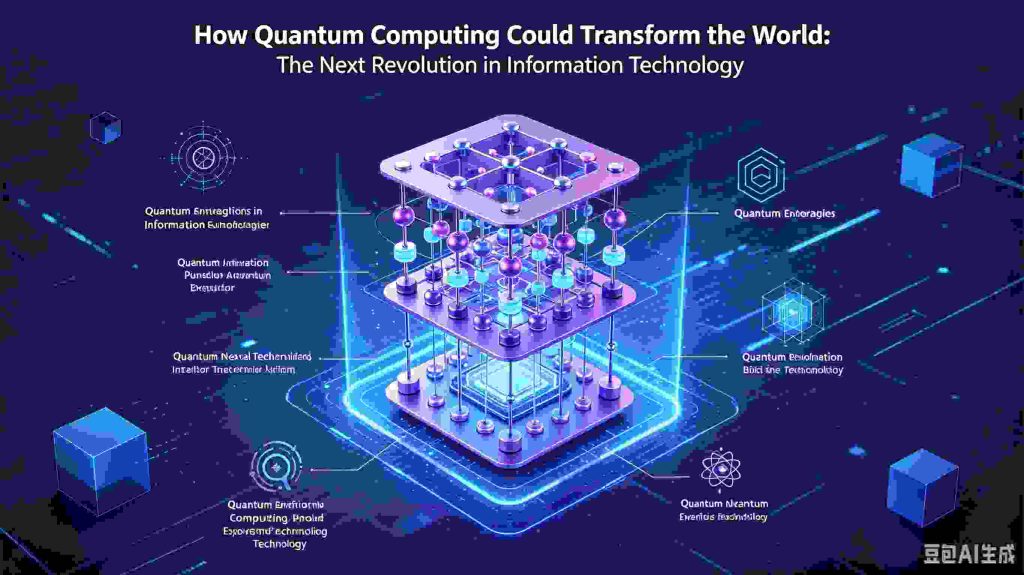
Classical computers process information using electronic circuits that operate with binary digits known as bits. Every calculation performed by a conventional computer is ultimately built upon combinations of zeros and ones. Quantum computers, however, rely on quantum bits, or qubits, which behave according to the strange laws of quantum mechanics. Unlike classical bits, qubits can exist in multiple states simultaneously through a phenomenon called superposition. This allows quantum computers to evaluate many possible solutions at the same time instead of examining them one after another. Another important principle, known as quantum entanglement, enables qubits to become interconnected in ways that allow information to be shared with extraordinary efficiency. Together, these properties provide the theoretical foundation for solving certain categories of problems dramatically faster than even the most advanced classical computers available today.
One of the most promising applications of quantum computing is pharmaceutical research and drug discovery. Developing new medicines often requires scientists to understand how atoms and molecules interact under different conditions, but accurately simulating these interactions is incredibly difficult using conventional computers. Quantum computers are naturally suited for modeling quantum systems because they operate according to the same physical principles that govern molecular behavior. Researchers believe this capability could significantly reduce the time required to discover new drugs, identify effective treatment combinations, and understand complex biological processes. Faster simulations may lead to breakthroughs in cancer therapies, treatments for neurological disorders, antiviral medications, and personalized medicine. Instead of relying on years of laboratory experiments alone, pharmaceutical companies could use quantum simulations to narrow promising candidates before clinical testing begins, accelerating innovation while reducing research costs.
Artificial intelligence and machine learning may also benefit enormously from advances in quantum computing. Modern AI systems require vast amounts of computational power to analyze enormous datasets, recognize patterns, and optimize decision-making processes. Quantum algorithms could potentially process complex optimization problems much more efficiently than traditional computing methods, enabling faster training of machine learning models and improving predictive accuracy. Industries ranging from healthcare and finance to logistics and climate science could use quantum-enhanced AI to analyze information at unprecedented scales. Although researchers are still developing practical quantum machine learning techniques, many believe the combination of AI and quantum computing could unlock entirely new approaches to scientific research, industrial automation, and intelligent decision-making that are currently beyond the capabilities of classical computing systems.
Cybersecurity represents both one of the greatest opportunities and one of the greatest challenges associated with quantum computing. Much of today’s digital security relies on encryption methods based on mathematical problems that are extremely difficult for classical computers to solve within a reasonable timeframe. However, sufficiently powerful quantum computers could theoretically solve some of these problems much more efficiently, potentially rendering existing encryption standards vulnerable. This possibility has motivated governments, technology companies, and academic researchers to develop quantum-resistant cryptographic algorithms capable of protecting sensitive information in a future where large-scale quantum computers become practical. At the same time, quantum technology may also improve security through quantum communication systems that use the laws of physics to detect unauthorized interception of transmitted information, creating entirely new methods for secure digital communication.
Beyond computing and cybersecurity, quantum technology has enormous potential to accelerate innovation across many scientific disciplines. Materials scientists hope quantum simulations will help design stronger alloys, more efficient batteries, advanced superconductors, and environmentally friendly industrial materials. Energy researchers may discover new catalysts that improve hydrogen production or increase the efficiency of solar panels. Financial institutions could use quantum optimization algorithms to improve investment strategies, portfolio management, and risk analysis by evaluating vast numbers of possible market scenarios more quickly than conventional systems. Transportation and logistics companies may optimize global supply chains, airline scheduling, shipping routes, and warehouse operations using quantum algorithms capable of solving highly complex optimization problems that currently require enormous computational resources.
Despite its extraordinary promise, quantum computing remains an extremely challenging technology to develop. Qubits are highly sensitive to environmental disturbances such as temperature fluctuations, electromagnetic interference, and mechanical vibrations. Even the smallest external influence can introduce errors that disrupt calculations before they are completed. Building stable quantum computers therefore requires sophisticated cooling systems, precise engineering, and advanced error-correction techniques. Researchers around the world are exploring multiple hardware approaches, including superconducting circuits, trapped ions, photonic systems, and neutral atoms, each offering unique advantages and technical challenges. While impressive progress has been made over the past decade, experts generally agree that practical, fault-tolerant quantum computers capable of solving large real-world problems are still several years away.
Looking ahead, quantum computing represents more than simply a faster version of today’s computers. It introduces an entirely new way of processing information that could reshape scientific discovery, technological innovation, and economic development throughout the twenty-first century. Universities, governments, and private companies are investing billions of dollars in quantum research because they recognize its transformative potential. As education expands and new generations of scientists and engineers enter the field, breakthroughs are likely to accelerate across multiple disciplines simultaneously. Although many technical challenges remain, history has repeatedly shown that revolutionary technologies often begin as ambitious scientific experiments before becoming essential tools in everyday life. Quantum computing may follow the same path, opening doors to discoveries that are currently beyond human imagination while fundamentally changing how society approaches some of its most difficult scientific and engineering problems.
-3-300x300.png)