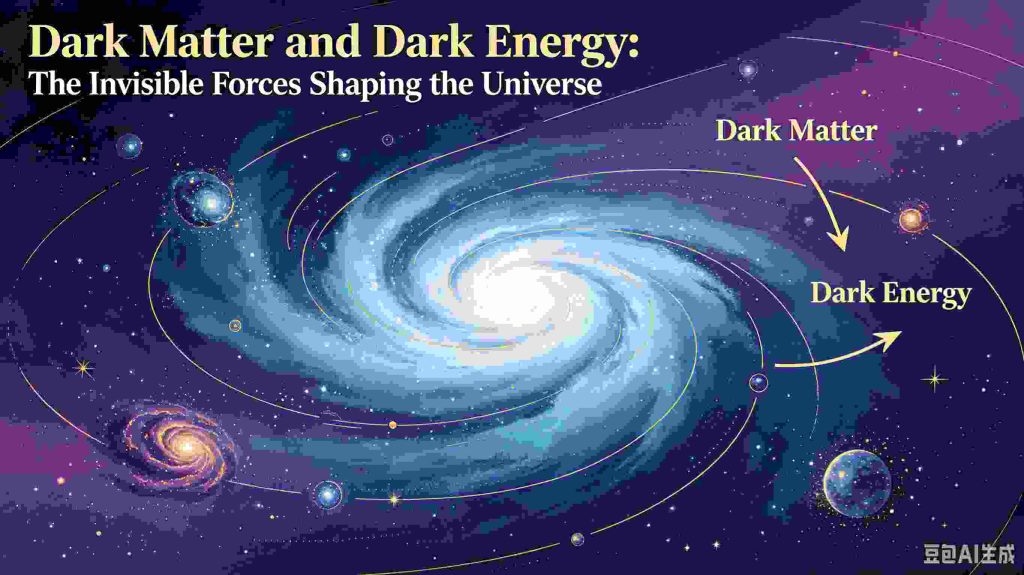
Dark matter was first proposed to explain discrepancies in the rotational speeds of galaxies. Observations showed that stars at the outer edges of galaxies were moving much faster than could be accounted for by the visible mass alone. According to Newtonian physics, these stars should have been flung into space, yet galaxies remain stable. This suggests the presence of an unseen form of matter providing additional gravitational force. Dark matter does not interact with electromagnetic radiation, which is why it cannot be detected directly. Instead, its presence is inferred through gravitational lensing, galaxy rotation curves, and large-scale cosmic structure formation. Scientists believe dark matter may consist of unknown subatomic particles, though no definitive detection has yet been made.
Dark energy, on the other hand, is a mysterious force responsible for the accelerated expansion of the universe. In the late 1990s, astronomers discovered that distant galaxies are moving away from each other at increasing speeds, contrary to expectations that gravity should slow expansion over time. This acceleration suggests the existence of a repulsive force or energy embedded in space itself. Unlike dark matter, which clumps around galaxies, dark energy appears to be uniformly distributed throughout the universe. Its exact nature is unknown, but it may be related to the cosmological constant, vacuum energy, or a previously undiscovered field. Understanding dark energy is essential for predicting the long-term fate of the universe.
Cosmological observations play a crucial role in studying dark matter and dark energy. Instruments such as the Hubble Space Telescope, the Planck satellite, and large ground-based observatories measure cosmic microwave background radiation, galaxy distributions, and supernova distances to infer the properties of the universe. These observations help scientists build models of cosmic evolution, showing how matter and energy interacted shortly after the Big Bang. Large-scale simulations of the universe also suggest that dark matter acts as a scaffolding, guiding the formation of galaxies and galaxy clusters through gravitational attraction. Without dark matter, the universe would look dramatically different, with far fewer large structures.
Particle physics experiments are actively searching for direct evidence of dark matter particles. Underground detectors, particle accelerators, and space-based instruments are designed to identify weakly interacting massive particles or other hypothetical candidates. Despite extensive efforts, no conclusive detection has been achieved yet. This has led scientists to consider alternative theories, including modifications to gravity itself. However, most evidence still strongly supports the existence of dark matter as a real physical component of the universe. The search continues to be one of the most important areas of research in modern physics.
The implications of dark matter and dark energy extend beyond astronomy and into fundamental questions about the nature of reality. These invisible components challenge our understanding of physics, suggesting that current models are incomplete. If dark energy continues to drive accelerated expansion, the universe may eventually expand so rapidly that galaxies become isolated from one another, leading to a cold, dark future often referred to as the “Big Freeze.” Alternatively, other models propose different outcomes depending on the behavior of dark energy over time. Understanding these forces is therefore essential not only for explaining the past but also for predicting the ultimate fate of the cosmos.
Advances in technology and international collaboration are gradually improving our ability to study these phenomena. Next-generation telescopes, such as the James Webb Space Telescope and future ground-based observatories, are expected to provide more detailed observations of distant galaxies and early cosmic structures. Improved particle detectors and experiments may eventually reveal the nature of dark matter particles. The combination of observational astronomy, theoretical physics, and computational modeling continues to push the boundaries of human knowledge.
Dark matter and dark energy remain among the most profound mysteries in science, representing the limits of current understanding. Although invisible, their influence shapes the entire universe, from the smallest galaxies to the largest cosmic structures. Continued research into these phenomena may lead to revolutionary discoveries that transform physics and our understanding of reality itself.
-3-300x300.png)