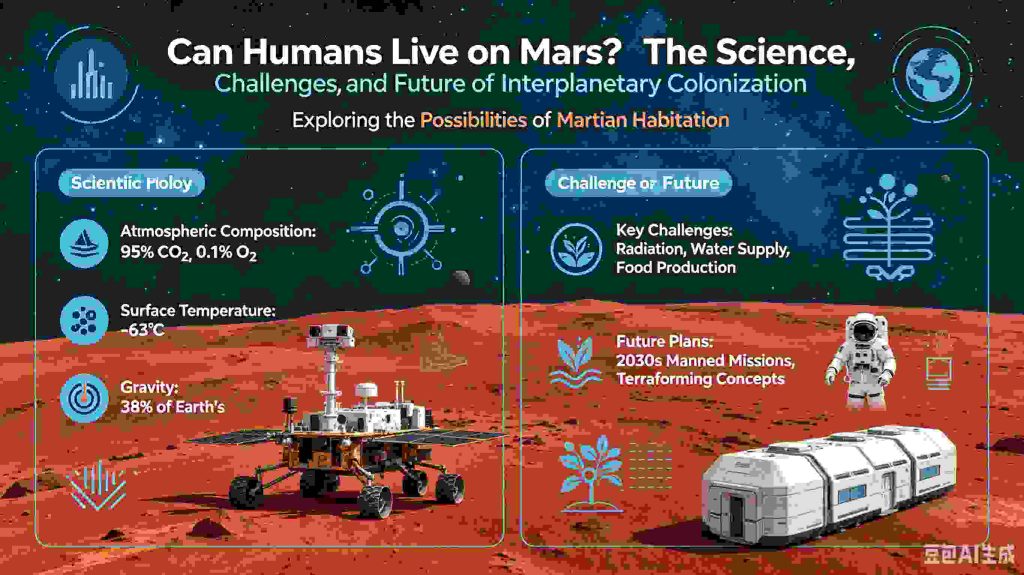
Mars has a thin atmosphere composed primarily of carbon dioxide, with only trace amounts of oxygen, making it unbreathable for humans without life-support systems. Atmospheric pressure on the surface is less than one percent of Earth’s, meaning that liquid water cannot exist stably under natural conditions for long periods. Temperatures on Mars are extremely cold, often ranging from below minus 60 degrees Celsius on average, with even colder conditions near the poles. Additionally, Mars lacks a global magnetic field, exposing its surface to high levels of cosmic and solar radiation. These environmental factors create a hostile environment that would be fatal to unprotected human life. Any attempt to establish a human presence on Mars must therefore rely on carefully designed habitats that can provide breathable air, stable temperature control, and protection from radiation.
One of the greatest engineering challenges in establishing a Martian settlement is developing sustainable life-support systems. Astronauts and future settlers would need a continuous supply of oxygen, water, and food. Oxygen can potentially be produced from the Martian atmosphere using chemical processes such as electrolysis of carbon dioxide. Water may be extracted from subsurface ice deposits, although locating and processing these resources at scale remains a major technical challenge. Food production would likely depend on controlled agricultural systems such as hydroponics or aeroponics, where plants are grown without soil in carefully regulated environments. These systems would need to be highly efficient, recycling nutrients and water to minimize resource consumption. Creating a closed-loop ecological system capable of supporting human life indefinitely is one of the most important goals of Mars colonization research.
Transportation between Earth and Mars presents another significant challenge. The distance between the two planets varies depending on their orbital positions, but even at their closest approach, Mars is tens of millions of kilometers away. Current spacecraft require several months to complete the journey, exposing astronauts to prolonged microgravity and cosmic radiation. Researchers are exploring advanced propulsion systems, such as nuclear thermal propulsion and ion drives, which could reduce travel time and improve mission safety. Launch windows for Mars missions occur approximately every 26 months, when planetary alignment allows for more efficient trajectories. These constraints mean that planning interplanetary missions requires precise timing, careful resource management, and extensive preparation to ensure crew survival and mission success.
Human health in a Martian environment is another critical concern. Extended exposure to low gravity can lead to muscle atrophy, bone density loss, and cardiovascular changes. Radiation exposure increases the risk of cancer and other long-term health issues. Psychological factors such as isolation, confinement, and distance from Earth also pose significant challenges for astronauts on long-duration missions. To address these issues, researchers are developing countermeasures such as artificial gravity systems, advanced radiation shielding, and psychological support strategies. Habitat design will also play an important role in maintaining mental well-being, with features such as natural lighting simulations, recreational spaces, and communication systems that allow regular contact with Earth.
Despite these challenges, significant progress is being made in preparing for human exploration of Mars. Robotic missions have already provided detailed information about the planet’s surface, geology, climate, and potential resources. Rovers and orbiters have discovered evidence of ancient riverbeds, seasonal methane fluctuations, and subsurface ice deposits, suggesting that Mars once had conditions that may have supported microbial life. These findings not only increase scientific interest but also help identify potential locations for future human bases. Space agencies and private companies are actively developing technologies required for crewed missions, including reusable rockets, advanced habitats, and in-situ resource utilization systems that allow materials on Mars to be used for construction and fuel production.
The concept of terraforming Mars, or transforming its environment to make it more Earth-like, has also been widely discussed in scientific and theoretical contexts. Proposed methods include releasing greenhouse gases to thicken the atmosphere, warming the planet to allow liquid water to exist on the surface, and introducing engineered microorganisms to gradually alter the environment. However, these ideas remain highly speculative and would require technologies far beyond current capabilities, as well as timescales spanning centuries or even millennia. For the foreseeable future, human presence on Mars would likely depend on enclosed habitats rather than large-scale planetary transformation.
Looking ahead, the possibility of humans living on Mars represents both a technological challenge and a philosophical milestone for humanity. Establishing a permanent presence on another planet would mark a significant step in human evolution as a spacefaring species. It would require advancements in engineering, biology, medicine, and environmental science, as well as international cooperation and long-term commitment. While many obstacles remain, ongoing research and exploration continue to bring this vision closer to reality. Whether through scientific research stations, commercial settlements, or future colonies, Mars remains a symbol of human curiosity and ambition, representing the next frontier in the ongoing exploration of our solar system.

-1-300x300.png)