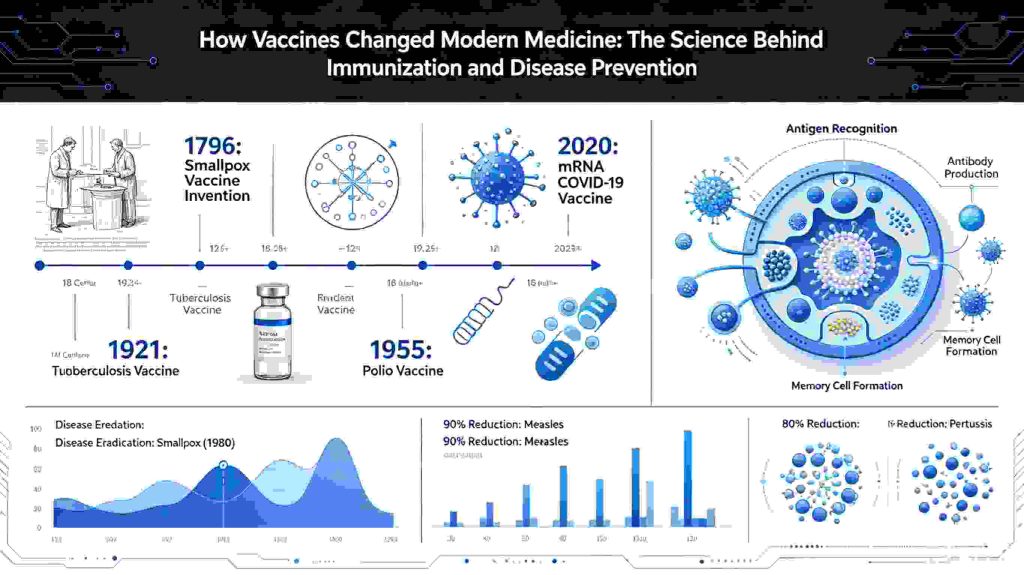
The immune system is a highly complex network of cells, tissues, and organs that work together to defend the body against harmful microorganisms such as bacteria, viruses, and parasites. When a pathogen enters the body, specialized immune cells recognize it as foreign and initiate a response designed to eliminate the threat. One of the most important components of this system is the production of antibodies, proteins that bind specifically to invading pathogens and neutralize them. After an infection, the immune system retains a memory of the pathogen, allowing it to respond more quickly and effectively if the same pathogen is encountered again. Vaccines take advantage of this natural immune memory by introducing harmless components or weakened forms of pathogens to stimulate an immune response without causing disease. This process trains the immune system in advance, preparing it to defend against future infections.
The development of vaccines has evolved significantly since the first successful smallpox vaccine was created by Edward Jenner in the late eighteenth century. Jenner observed that milkmaids who had contracted cowpox appeared to be protected from smallpox, leading him to develop a method of immunization using material from cowpox lesions. This discovery laid the foundation for the field of immunology and demonstrated the principle of cross-protection between related pathogens. Over time, scientific advances led to the development of more sophisticated vaccines, including inactivated vaccines, live-attenuated vaccines, subunit vaccines, and, more recently, mRNA vaccines. Each type of vaccine uses a different approach to safely expose the immune system to antigens, allowing for tailored strategies depending on the nature of the disease being targeted.
One of the most remarkable success stories in vaccine history is the eradication of smallpox. Through a coordinated global vaccination campaign led by the World Health Organization, smallpox was declared eradicated in 1980, making it the first and only human disease to be completely eliminated. This achievement demonstrated the power of international cooperation in public health and highlighted the effectiveness of widespread immunization programs. Other diseases, such as polio, have also been dramatically reduced worldwide, with ongoing vaccination efforts bringing the world closer to complete eradication. These successes illustrate how vaccines not only protect individuals but also contribute to herd immunity, a phenomenon in which a sufficiently large proportion of the population becomes immune, reducing the overall spread of disease.
Vaccines also play a critical role in preventing seasonal and emerging infectious diseases. Influenza vaccines are updated annually to match circulating viral strains, helping reduce the severity and spread of seasonal flu outbreaks. During global health emergencies, such as the COVID-19 pandemic, vaccines developed using novel technologies like mRNA platforms were produced and distributed at unprecedented speed. These vaccines demonstrated high effectiveness in reducing severe illness, hospitalizations, and deaths, highlighting the importance of scientific innovation in responding to rapidly evolving pathogens. The ability to develop and deploy vaccines quickly has become an essential tool in managing global health crises and preventing widespread societal disruption.
Despite their proven effectiveness, vaccines often face challenges related to public perception, misinformation, and accessibility. Misunderstandings about vaccine safety and side effects can lead to vaccine hesitancy, which reduces immunization rates and increases the risk of disease outbreaks. Scientific evidence consistently shows that vaccines undergo rigorous testing for safety and efficacy before being approved for public use, and serious adverse effects are extremely rare. Public health organizations emphasize the importance of transparent communication and education to address concerns and build trust in vaccination programs. Ensuring equitable access to vaccines across different regions of the world is also a major challenge, as disparities in healthcare infrastructure and resources can limit distribution in low-income areas.
The economic impact of vaccines extends beyond healthcare systems, influencing productivity, education, and global development. By preventing illness, vaccines reduce the burden on hospitals and healthcare providers, lowering medical costs and freeing resources for other health needs. Healthy populations are more productive, allowing individuals to participate fully in education and the workforce without interruption from preventable diseases. In addition, vaccination programs contribute to economic stability by reducing the likelihood of large-scale outbreaks that can disrupt supply chains, travel, and commerce. From a global perspective, investing in vaccination is considered one of the most cost-effective public health interventions available.
Research in immunology and vaccine development continues to advance rapidly, opening new possibilities for preventing a wider range of diseases. Scientists are exploring vaccines for conditions such as malaria, HIV, tuberculosis, and certain types of cancer. Cancer vaccines, for example, aim to train the immune system to recognize and destroy tumor cells, representing a promising area of personalized medicine. Advances in genetic sequencing, molecular biology, and biotechnology are enabling researchers to design more precise and effective vaccines than ever before. As scientific understanding deepens, future vaccines may become more universal, longer-lasting, and capable of addressing diseases that were once considered impossible to prevent.
Vaccines have fundamentally reshaped the landscape of modern medicine by shifting the focus from treatment to prevention. They represent one of the most powerful tools available for protecting human health, reducing mortality, and controlling infectious diseases on a global scale. Continued investment in research, education, and healthcare infrastructure will be essential for maintaining and expanding the benefits of vaccination. As new diseases emerge and global populations continue to grow, vaccines will remain a critical component of public health strategy. Their impact on human history is profound, and their potential for future medical innovation continues to expand, offering hope for a healthier and more resilient world.