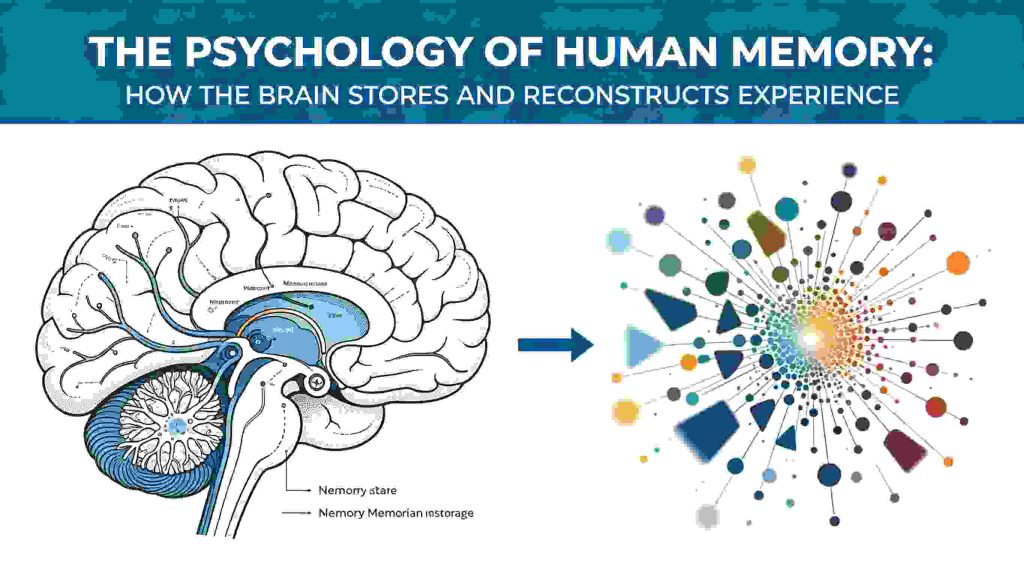
Memory formation begins with encoding, a process in which sensory information is transformed into a format that the brain can store. This involves multiple brain regions, but the hippocampus plays a central role in organizing and consolidating new experiences. When a person sees, hears, or experiences something meaningful, neurons in different parts of the brain fire in specific patterns that represent that information. These patterns are then strengthened through synaptic plasticity, a process where connections between neurons become stronger with repeated activation. Attention plays a critical role in encoding; without focused attention, information is often not properly stored and is quickly forgotten. This explains why multitasking often reduces learning efficiency and why emotionally significant events tend to be remembered more vividly than neutral experiences.
Once encoded, memories are stored across different brain networks depending on their type. Episodic memories, which involve personal experiences, are linked to the hippocampus and prefrontal cortex, while semantic memories, such as facts and knowledge, are distributed across the cerebral cortex. Procedural memory, which involves skills like riding a bicycle or typing, is associated with the basal ganglia and cerebellum. This distributed system allows the brain to efficiently store vast amounts of information without relying on a single location. Over time, memories undergo consolidation, a process that stabilizes and reorganizes information, often occurring during sleep. During this phase, the brain replays neural activity patterns, strengthening important connections and integrating new information with existing knowledge.
Memory retrieval is the process of accessing stored information when needed, but this process is not always reliable. Retrieval depends on cues such as context, emotions, and associations that help the brain reconstruct past experiences. Interestingly, remembering is not a passive playback of stored data but an active reconstruction process. Each time a memory is recalled, it can be slightly modified, influenced by current emotions, beliefs, and new experiences. This means that memories can change over time, sometimes becoming more distorted or less accurate. Research in cognitive psychology has shown that even confident memories can contain inaccuracies, which has important implications for legal systems, historical accounts, and personal decision-making.
Forgetting is often misunderstood as a failure of memory, but it is actually an essential cognitive function. The brain is constantly filtering information to prioritize what is important and discard what is irrelevant. Without forgetting, the brain would become overloaded with unnecessary data, making efficient thinking impossible. Several mechanisms contribute to forgetting, including decay of neural connections, interference from similar memories, and retrieval failure. In some cases, forgetting is adaptive, allowing individuals to move on from traumatic or outdated information. However, excessive forgetting or memory impairment can be a symptom of neurological conditions such as Alzheimer’s disease or other forms of dementia, which involve progressive degeneration of brain tissue.
Emotion has a powerful influence on memory formation and retrieval. The amygdala, a brain region involved in emotional processing, interacts closely with the hippocampus to strengthen memories associated with strong emotions such as fear, joy, or stress. This is why emotionally charged events, such as accidents or major life milestones, are often remembered more clearly than ordinary daily experiences. However, extreme stress can sometimes impair memory formation, particularly when cortisol levels are elevated for prolonged periods. This relationship between emotion and memory is important in understanding psychological conditions such as post-traumatic stress disorder, where traumatic memories become highly persistent and intrusive.
Neuroscientists have also discovered that memory is highly adaptable and can be modified through therapeutic techniques. Cognitive behavioral therapy, for example, helps individuals reframe negative memories and reduce their emotional impact. Emerging research in memory reconsolidation suggests that when memories are reactivated, they temporarily become malleable before being stored again, offering potential opportunities for therapeutic intervention. This could lead to treatments for anxiety disorders, phobias, and trauma-related conditions by altering how distressing memories are stored and retrieved in the brain.
Technological advancements are also enhancing our understanding of memory. Brain imaging techniques such as fMRI and EEG allow scientists to observe neural activity during memory tasks. Artificial intelligence models are being used to simulate memory processes and better understand how information is encoded and retrieved. In the future, technologies such as brain-computer interfaces may even allow partial enhancement or restoration of memory function in individuals with neurological damage. While still experimental, these developments raise both exciting possibilities and ethical questions about cognitive enhancement.
Memory is not just a biological process but a fundamental aspect of human identity and experience. It allows individuals to learn from the past, plan for the future, and maintain a continuous sense of self over time. Although imperfect and sometimes unreliable, memory is essential for all aspects of cognition and behavior. Continued research into the science of memory will not only deepen our understanding of the brain but also improve education, mental health treatment, and artificial intelligence systems designed to replicate human learning.